The Essential Guide to IoT Connectivity: Solutions, Technologies, and the LoRaWAN Advantage

What is IoT Connectivity and Why it Matters for Your Business
A friend of mine reached out the other day asking what to use to track a [redacted] at pretty decent volume, with a freight value of $200,000/day. It opened up the conversation about IoT connectivity, and what to use when.
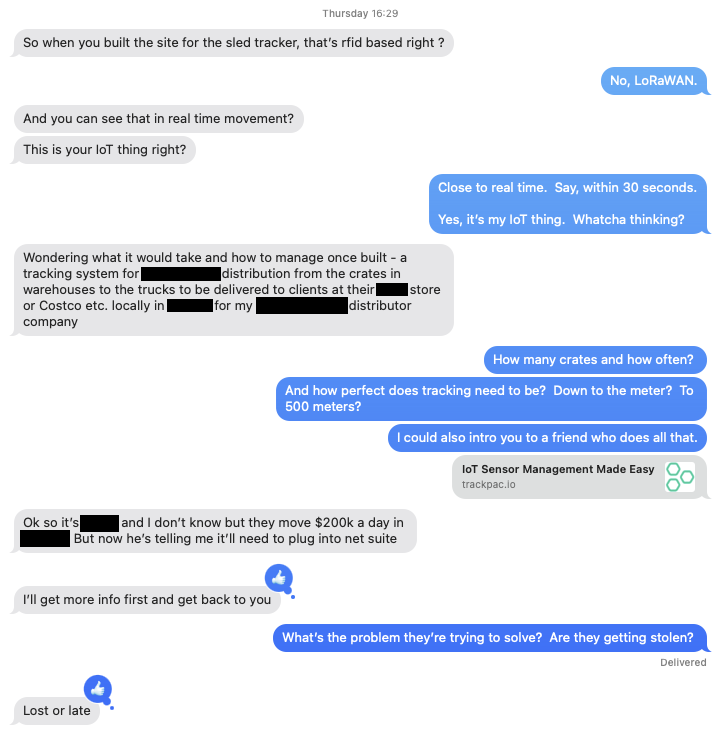
It made me realize that for those of us in the thick of it, the difference between LoRaWAN and RFID is apparent, but if you're just learning about this IoT thing and haven't given any thought about how the data actually moves from where it is to where you need it, or even why, you might want a primer.
So I wrote it. I'm biased towards LoRaWAN, but there are lots of other options out there, all of them the right fit for a specific solution set.
Technically, what my friend (I'll call her "Alice") wants is an iot connectivity solution, but if ya lead with that without defining anything, you've lost already. Let's start with what IoT connectivity is.
What is IoT Connectivity? A Simple Definition
At its core, IoT Connectivity is the way sensors connect to the internet. Whether you want to track package or crates, the weather or whether or not your motor is running hot, there are four giant pieces of that puzzle:
- The sensor itself
- How it connects
- How the data is handled (stored or read and discarded)
- What you do with the information (dashboard, actions, alerts, etc)
Visualizing the Connection: The IoT Connectivity Diagram
To understand the flow of data, it helps to visualize the architecture from the edge to the cloud. We'll start using the technical names here:
- Devices
- IoT Gateway
- Network Server
- Cloud Dashboard

Those are the four big parts, but in this post we're going to focus on how connect step 1 (the Device) to step 2 (the IoT Gateway). That's what IoT connectivity is.
IoT connectivity separates into two main channels, wired and wireless. Today, we'll focus on the Wireless channel.
Wireless IoT connectivity is what hundreds of millions of sensors use to connect around the world, whether they use WiFi, Bluetooth, LoRaWAN (or any of the LPWANs) or LTE. Relax, we'll define all of those. By the end of this article, you will have an excellent grasp of what IoT connectivity is, does, and how you should choose between them.
We'll start by talking about the problems you want to solve when connecting your device to the internet.
Many terms in IoT are used interchangeably. Device and sensor usually mean the same thing, and that's how we'll use 'em here.
Addressing the Key IoT Connectivity Challenges (Power, Range, and Cost)
When designing a sensor network you are always balancing three main trade-offs: Range, Bandwidth (Data Rate), and Power Consumption. Understanding these constraints is the first step in choosing the right technology.
They're linked, so the further you want to send your data the less volume of data you can send, but as you send less data it costs less power.
You want to think here about what the problem is you're trying to solve; are you just getting GPS coordinates (very small pieces of data) or do you need to send high-def video? Are you connected to the power grid with no limits on how much power you can use, or are you running off a credit card sized battery that needs to last for years?

Each of these determines what the best IoT connectivity solution for YOU is.
A Deep Dive into IoT Connectivity Technologies
The way information is transmitted wirelessly is called a "radio protocol". WiFi is a radio protocol, as is BLE, or Bluetooth. LoRaWAN is another, and cellular is yet another.
Understanding Key IoT Networking Connectivity Protocols
Short-Range and High-Bandwidth (Wi-Fi, Bluetooth, NFC)
These protocols are ubiquitous in smart homes and consumer electronics where power is readily available or batteries can be easily replaced. They offer high bandwidth but suffer from short range and high power draw.
WiFi lets you blast 4k video to your big screen TV, and bluetooth makes it easy for your phones to connect with all your little devices around the house, from a heart rate monitor for a long run to managing your smart toothbrush.
WiFi range is about 300' (100m for the rest of the world), and Bluetooth is about 30' (10m).
Basically, they're between the range a 12 year old could throw a basketball (Bluetooth) and a pro NFL quarterback could zing a football on his best day (WiFi).
There are other wireless communication options, like RFID and NFC, but the ranges are so low and use cases so specific (a reader needs to be right next to the device) that they're not practical for IoT connectivity, though they're great for paying with your credit card at the store.
| Feature | LoRaWAN (LPWAN) | NB-IoT (Cellular LPWAN) | LTE-M (Cellular LPWAN) | Wi-Fi / Bluetooth (Short Range) |
|---|---|---|---|---|
| Range | Very Long (Kilometers) | Long (Kilometers) | Long (Kilometers) | Short (Meters) |
| Data Rate (Bandwidth) | Very Low (Bytes/Sec) | Low (Tens of Kbps) | Medium (Hundreds of Kbps) | Very High (Mbps) |
| Power Consumption | Extremely Low | Low | Medium | High |
| Network Type | Unlicensed Spectrum | Licensed Cellular | Licensed Cellular | Unlicensed Spectrum |
| Cost | Low (Minimal Infrastructure) | Medium (Per-SIM fee) | Medium-High | Very Low (Local) |
| Best For... | Remote sensing, Asset Tracking of non-critical data | Deep indoor penetration, moderate data volume | Mobility, moderate-to-high data volume | High-volume data, local control (e.g., in a lab) |
Licensed Cellular (4G/LTE, 5G) and NB-IoT/LTE-M
With the obvious no-gos out of the way, we come to realistic options (though not always the best ones) for IoT devices in the wild. The first and obvious one is using cell towers. There are millions of them around the world, and they already have radios and antennas on 'em. They're purpose built for collecting radio waves, BUT they have some drawbacks.
First, they're expensive to set up and maintain, and if you're relying on something that needs a cell tower but you don't have a cell tower there to receive the signal, you're stuck.
Second, cellular radios (LTE) are chatty. Even when they go to "sleep" they still need power to maintain connectivity, making them poor candidates for solutions that need very low maintenance over the long term.
Third, every device needs a SIM card (or eSIM) and a monthly subscription. Yes, there are ways around this, but at the base of it you're relying on someone else's network, a network that cost them millions of dollars to build. They're not going to let you use it for free, or even cheap.
Fourth, cell towers were built for people, not sensors. Cellular networks offer high reliability and data rates. NB-IoT (Narrowband IoT) is a specific cellular standard designed for low-power wide-area applications, making it a direct competitor to LoRaWAN.
They cover cities and highways, parking lots and pavement. Cell towers don't typically cover deep valleys, basements, or remote agricultural areas where your data is often collected from. LTE and NB-IoT are a good solution if you have a nearby cell tower, but if you don't...a new cell tower costs a million bucks to install.
The equivalent coverage by a LoRaWAN gateway is $200 for the gateway and you can install it in half an hour on any building, structure, or even in a tree.
But wait, what's a "gateway"?
The Role of the IoT Gateway in LoRaWAN Architecture
The IoT Gateway acts as the bridge between the local LoRaWAN network and the internet (via Ethernet, Wi-Fi, or Cellular), forwarding encrypted packets from sensors to the Network Server. It's an essential part of our connectivity, and knowing a little about gateways will help you avoid major headaches later on.
First, gateways have different costs. A cell tower is effectively the 'gateway' for LTE and NB-IoT. To add coverage where you don't have it requires building a new tower site, which can cost hundreds of thousands to millions of dollars. Even if you skip the tower and set up a small 'Private LTE', that will require specialized engineering and hardware costing tens of thousands of dollars.
You might see devices like the Teltonika TRB series sold as "Cellular Gateways" for $150. These are powerful cellular modems that connect wired devices (like RS485 sensors) to the internet.
However, they generally don't create their own Long Range Wireless Network. They rely on a nearby cell tower and licensed spectrum, which isn't cheap, to work. In contrast, a LoRaWAN Gateway works in unlicensed spectrum, so anyone can use it. It allows anyone to quickly, cheaply, and easily create a miles-wide umbrella of wireless coverage that hundreds of battery-powered sensors can connect to without running any wires.
Navigating IoT Connectivity Platforms, Solutions, and Providers
Defining an IoT Connectivity Management Platform
An IoT Connectivity Management Platform is the software layer that handles SIM/device provisioning, monitoring, billing, and security.
In the LoRaWAN world, this is often your Network Server (like Helium, The Things Network, or a public ChirpStack instance like MeteoScientific).
Criteria for Choosing an IoT Connectivity Provider
When evaluating providers, consider coverage, security features, scalability, and pricing models.
| Platform Feature | Description | Business Value for Technical Users |
|---|---|---|
| Real-Time Monitoring & Diagnostics | Instant visibility into device connection status, data usage, and alerts. | Prevents costly downtime and speeds up troubleshooting by identifying failed IoT Gateways or sensors immediately. |
| Centralized Provisioning & Activation | Over-the-air activation and bulk management of devices (LoRaWAN nodes, SIMs). | Enables rapid, low-cost scaling for large projects (e.g., thousands of remote sensors). |
| Security & Authentication | Secure device-level encryption, key management, and data access control. | Protects sensitive meteorological data and ensures compliance with data protection laws. |
| Data Routing and Integration | Automatic routing of sensor data to the final cloud platform (e.g., AWS, Azure). | Reduces integration complexity and delivers data quickly from the Network Server to analysis tools. |
| Billing and Cost Optimization | Granular usage tracking and custom usage thresholds for data. | Essential for managing recurring costs, especially in mixed Cellular/LPWAN deployments. |
Real-World Applications and Case Studies with LoRaWAN
LoRaWAN as IIoT (Industrial Internet of Things) connectivity is used throughout industry, from small companies you probably haven't of out to global giants like Volvo. Yep, that Volvo. During a conversation I had back in May of 2025 with Julien Bertolini, we talked about how Volvo is using LoRaWAN to track everything from where vehicles are on multi-acre lots to preventative maintenance on the shop floor.
LoRaWAN for Environmental and Meteorological Monitoring
One of my personal favorite uses of LoRaWAN is for weather stations. This is a hand-in-glove fit for LoRaWAn, as weather stations are often in remote and hard to access places, need to run on very low power, and don't send a ton of information.
Global networks like WeatherXM rely on Helium's LoRaWAN to retrieve weather information around the world, from the suburbs of San Diego to the wilds of Africa.
LoRaWAN's ability to send small packets of data over miles makes it ideal for remote weather stations, soil moisture sensors, and flood monitoring systems where changing batteries is difficult or expensive.
Industrial IoT (IIoT) and Remote Asset Tracking
When you start getting into large numbers of assets to track (which was where we started this conversation), you can roll your own or just turn to professional asset tracking companies like TrackPac, which offers an entire platform built on tracking whatever it is you want, with any kind of hardware.

| Application / Sensor Type | Key Connectivity Requirement | LoRaWAN Benefit |
|---|---|---|
| Remote Weather Stations | Reliable connection over large rural areas | Long-Range and Low-Power (Years of battery life) |
| Soil Moisture / Irrigation | Low data volume, high density of sensors | High device capacity and low-cost hardware |
| Air Quality Monitoring | Data reporting from urban street furniture | Deep penetration/coverage in dense areas |
| Water Level Monitoring (Flood Risk) | High durability, low-maintenance connection | Resilience and minimal infrastructure overhead |
IoT gateways are also exceptionally fun to install on mountaintops. Here's a picture of me with my third-ever install of a LoRaWAN gateway, this one up on a mountain in the backcountry of San Diego. We used a large sector antenna to blanket a huge portion of San Diego to the west with coverage. This single gateway has picked up remote sensors over 50 km away!

Common IoT Connectivity Challenges (Range, Power, and Cost)
Every IoT deployment eventually runs into the laws of physics. You cannot have infinite range, infinite bandwidth, and zero power consumption. Understanding these IoT connectivity challenges is often the difference between a pilot project that scales and one that dies in the "PoC Graveyard."
1. The Power vs. Maintenance Trap
The biggest hidden cost in IoT data connectivity isn't the hardware; it's the truck roll. If you deploy 1,000 sensors that use Wi-Fi or standard Cellular, you might be changing batteries every 6-12 months.
- The Challenge: Changing a battery costs $50-$200 in labor per device.
- The Fix: Use LPWAN technologies (LoRaWAN) that allow for 5-10 year battery life, effectively making the device "deploy and forget."
2. The "Basement and Bunker" Signal Problem
Radio waves hate concrete and earth. A common connectivity for IoT failure mode is testing a device on a desk (where it works perfectly) and then deploying it inside a steel walk-in freezer, a basement utility room, or a dense forest.
- The Challenge: High-frequency signals (Wi-Fi, Bluetooth, 5G) bounce off obstacles.
- The Fix: Lower frequency sub-GHz protocols (like LoRaWAN at 915 MHz) have much better physics for penetrating dense materials and terrain.
3. Scale and Data Cost
As your fleet grows from 10 to 10,000 devices, recurring costs can kill your ROI.
- The Challenge: Paying $5/month per SIM card is negligible for one device ($60/year), but catastrophic for 10,000 devices ($600,000/year).
- The Fix: Owned infrastructure. By deploying your own LoRaWAN gateways, you cap your connectivity costs at the price of the hardware, decoupling your growth from your monthly opex.
LoRaWAN Connectivity Troubleshooting Best Practices
When your IoT connectivity fails, it’s rarely the radio breaking; it’s usually physics getting in the way. Before you rip out a sensor, run through this checklist:
- Check the RSSI and SNR:
- RSSI (Received Signal Strength Indicator): If this is below -120 dBm, your signal is whispering. You need to move the gateway closer or higher. You can also get stung the other way when trying to get a join; always make sure your device is at least a room away from you.
- SNR (Signal-to-Noise Ratio): If this is negative (e.g., -10 dB), the background noise is louder than your signal. You might have interference from heavy machinery or other radio gear.
- The Fresnel Zone is Real:
- Line of sight isn't just a straight laser beam; it's a football-shaped zone between antennas. If a tree or building cuts into that zone, your range drops drastically.
- Gateway Placement:
- Height is king. Moving a gateway from a desk to a roof can double or triple your coverage radius.
The Future of IoT Connectivity: Security and Global Scale
As we move from millions to billions of devices, we are faced with the hurdles of keeping them secure and keeping them connected everywhere.
Addressing the Challenges of IoT Security with AI
As networks grow, so does the attack surface. While LoRaWAN uses robust AES-128 encryption by default, the complexity of managing millions of keys and device behaviors is exploding.
This is where AI-Native Toolchains come in. Modern embedded development isn't just about writing code; it's about using AI to monitor, test, and secure the entire workflow. I recently explored this topic in depth on the podcast:
- Listen: AI-Native Toolchains with Thomas Froment (Eclipse Foundation)
- We discuss how vendor-neutral, open-source tools are transforming how we build and secure these massive IoT deployments.
The Role of Unlicensed Networks in a Globally Connected World
Unlicensed spectrum technologies like LoRaWAN allow for democratized, community-built networks that can scale globally without the friction of traditional telecom contracts. Combined with new satellite-to-device connectivity (filling the gaps where gateways can't reach), we are approaching a truly contiguous global mesh of low-power connectivity.
So Now You Know...
We started off with my friend "Alice" asking me how to use IoT to track $200,000 worth of goods per day. It's probably been a longer answer than she was ready for, but she, and you, now have the tools required to wade through the many IoT connectivity options and make the right choice for the work you're doing.
Best of luck with it, and if you need a guiding hand, don't be afraid to reach out.
To your connected success!